Clikkle HR
Clikkle — May 2024
My Role
Full-stack Developer (UI/UX, Backend) — Contributed significantly to the end-to-end development of Clikkle HR, working across UI/UX design, frontend development, backend engineering, database architecture, cloud deployment, and performance optimization to build scalable, user-centric HR solutions and enhance overall platform efficiency and reliability.
Tech Stack

NextJS

ReactJS

TypeScript

MongoDB

ExpressJS

NodeJS

Redis

AWS

TanStack Query

Redux

Material UI
Timeline & Status
Q2 2024, Launched in May 2024
Overview
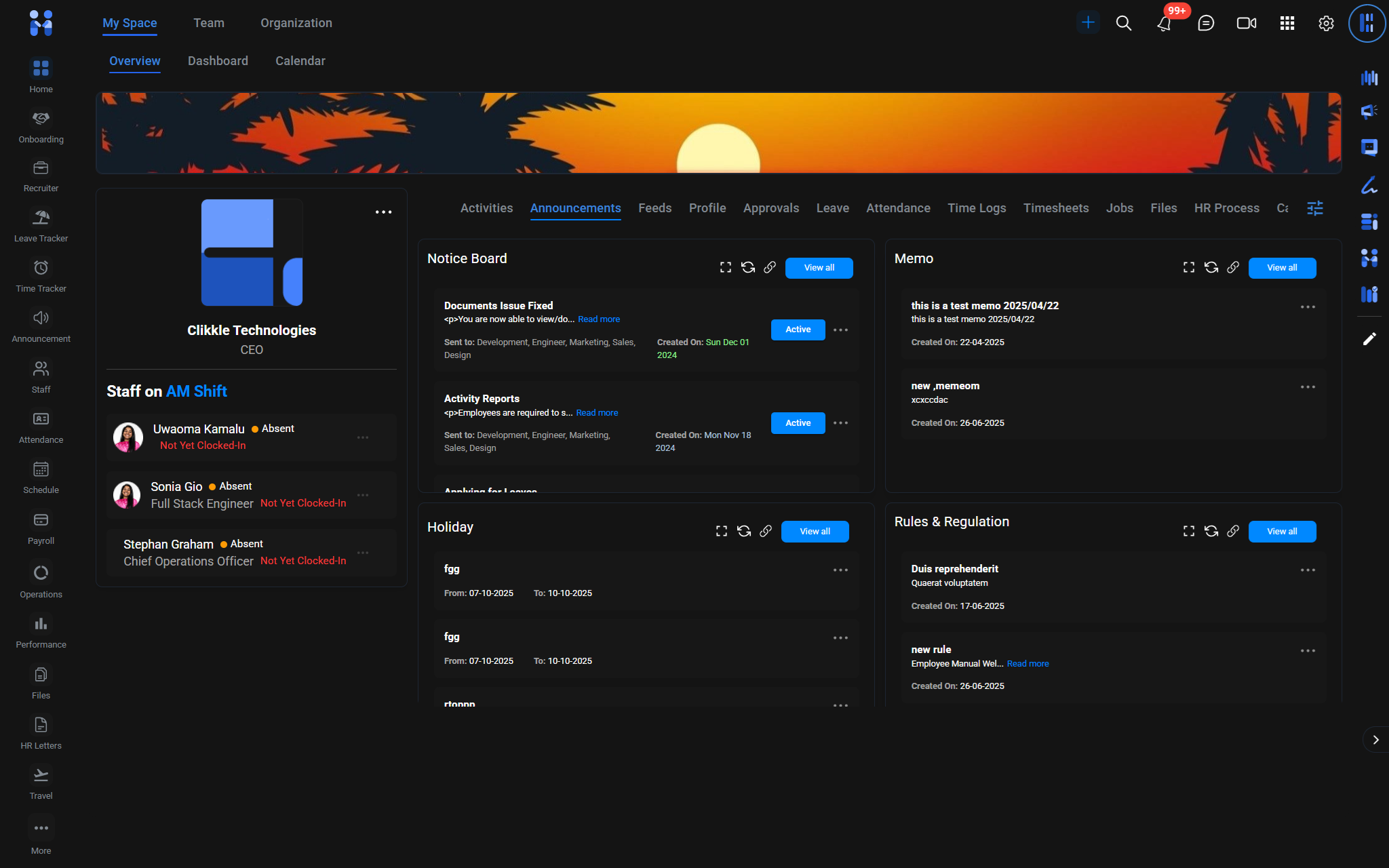
Clikkle HR is an end-to-end workforce management platform designed to simplify and automate core HR operations for businesses. The platform brings key HR functions such as employee management, recruitment, onboarding, attendance tracking, payroll processing, performance management, and compliance into a single integrated system. Its goal is to reduce manual administrative work while improving efficiency, accuracy, and employee experience.
The platform focuses on helping organizations manage the complete employee lifecycle through centralized and data-driven HR processes. Features like employee self-service, automated workflows, analytics, and secure record keeping allow HR teams to shift from routine paperwork to more strategic workforce planning and talent development. Clikkle HR also emphasizes scalability and digital transformation, making it suitable for modern businesses looking to streamline HR operations and improve productivity across departments.
Highlights
 HIGHLIGHTS
Several engineering and architectural decisions played a major role in improving scalability, workflow automation, and intelligent assistence
Context
Digitizing Workforce Operations Across the Clikkle Ecosystem
The Bigger Picture
As the Clikkle ecosystem expanded, organizations required a centralized workforce management system capable of handling employee operations, attendance, approvals, leave management, and organizational workflows within a unified environment. Existing HR processes were fragmented across spreadsheets, manual approvals, emails, and disconnected tools, resulting in operational inefficiencies and poor visibility across teams.
The platform was envisioned as a foundational business product that could simplify HR operations while integrating seamlessly with other applications inside the Clikkle ecosystem. The objective was not only to automate repetitive HR tasks, but also to create a scalable infrastructure capable of supporting growing organizations, distributed teams, and future ecosystem-wide integrations.
The system needed to support employee lifecycle management from onboarding to attendance tracking and leave approvals while remaining intuitive for HR teams, managers, and employees. Scalability, flexibility, automation, and performance became key architectural priorities from the beginning.
The Problem
Managing workforce operations at scale was becoming increasingly inefficient.
 THE CHALLANGE
Build a scalable HR management platform capable of automating workforce operations, reducing manual overhead, and supporting growing organizations without creating operational complexity.
Fragmented HR Workflows
Many HR operations depended heavily on spreadsheets, emails, and manual approvals which created repetitive administrative work, inconsistent employee records, approval delays, and limited visibility into attendance, leave balances, and workforce activities. As organizations scaled, these manual processes became increasingly difficult to maintain efficiently.
Complex Attendance & Leave Logic
Attendance tracking, leave approvals, payroll-related calculations, and shift-based workflows introduced complex edge cases around time tracking, holidays, overtime, approval hierarchies, and reporting accuracy. Designing flexible workflows while maintaining simplicity for end users became a major engineering challenge.
Scalability & Data Consistency
As employee records, attendance logs, and organizational data increased, the platform needed to remain performant, reliable, and maintainable. Poorly optimized queries, inconsistent data relationships, and growing operational complexity could quickly create performance bottlenecks if the architecture was not planned carefully from the beginning.
Goals & Objectives
Designing an HR Platform Focused on Automation and Scalability
Centralize Workforce Operations
Build a unified platform where HR teams, managers, and employees could manage attendance, employee records, leave requests, approvals, and organizational workflows from a single system instead of relying on fragmented tools and spreadsheets.
Reduce repetitive administrative tasks through automation, workflow optimization, centralized data management, and self-service employee capabilities while improving transparency and process visibility across organizations.
Build for Long-Term Growth
Design a scalable architecture capable of supporting growing organizations, increasing employee data, future integrations, and evolving HR workflows without major infrastructure limitations or technical debt.
Key Features
Built for Workforce Management, Automation, and Collaboration
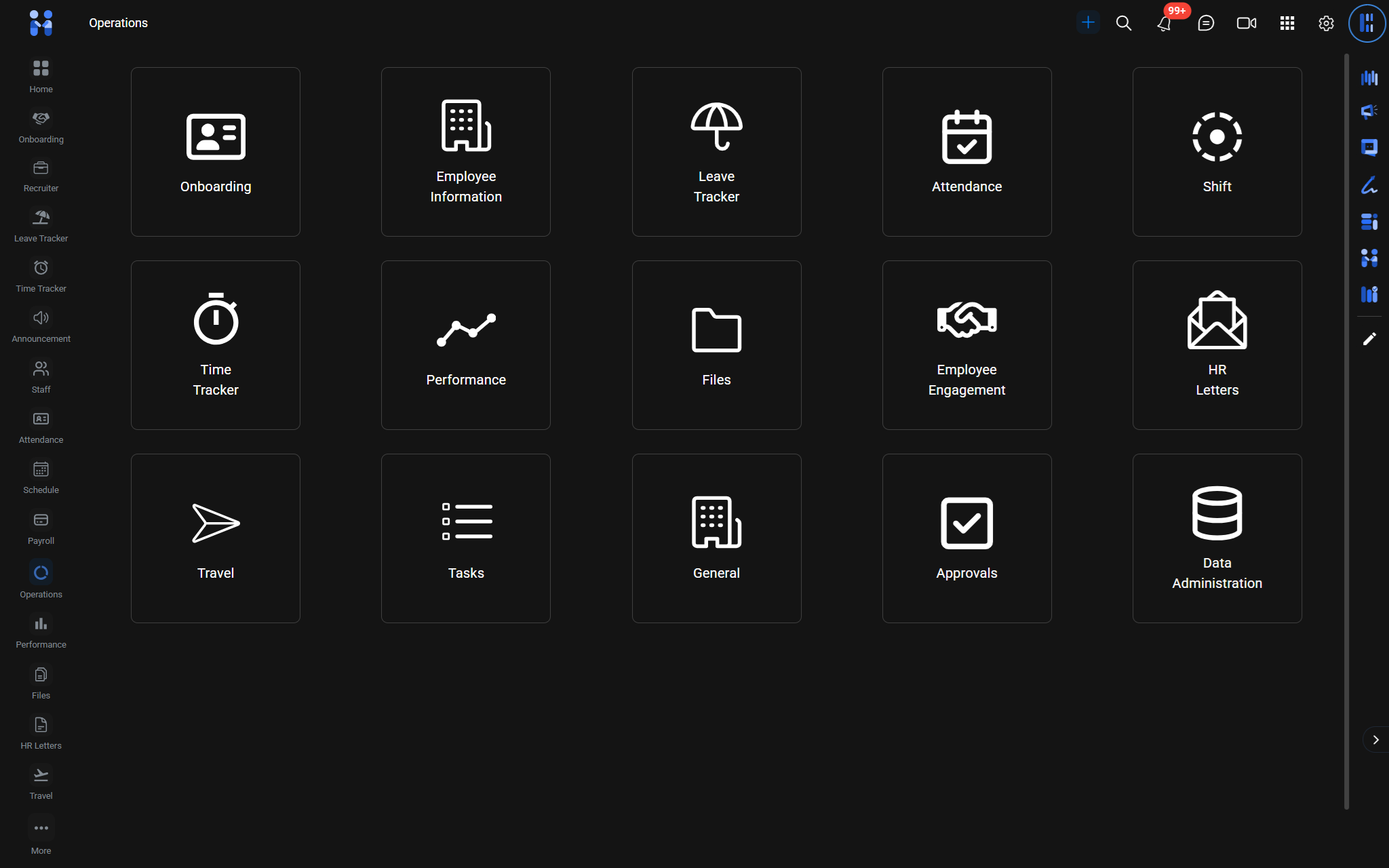
Employee & Organization Management
The platform supported employee onboarding, department structures, role assignments, employee profiles, document management, and centralized organizational records, allowing HR teams to manage workforce data from a single interface efficiently.
Attendance, Leave & Approval Workflows
Implemented attendance tracking, leave requests, approval hierarchies, holiday management, shift workflows, and real-time attendance visibility with automated calculations and reporting systems designed to reduce manual effort and improve accuracy.
Analytics & Employee Experience
The system provided dashboards, activity visibility, reporting capabilities, and employee self-service features that improved transparency and reduced dependency on HR teams for routine operations while maintaining a responsive and user-friendly experience.
Technical Decisions
Engineering Decisions That Improved Scalability and Reliability
Frontend Architecture Strategy
React and Next.js were used to create a fast and responsive user experience with modular UI components, optimized rendering, scalable routing, and maintainable frontend architecture. Redux and TanStack Query helped manage complex application state, caching, and asynchronous workflows efficiently.
Backend & Database Design
Node.js and Express.js powered the backend APIs and business logic while MongoDB handled workforce data including employees, departments, approvals, and attendance records. Database indexing and query optimization played an important role in maintaining performance as organizational data scaled.
Cloud & Performance Optimization
The application was deployed on scalable AWS cloud infrastructure with a modular backend architecture designed for maintainability, reliability, and future scalability. Redis caching was implemented to improve API response times and reduce server load, while Kafka was used for efficient asynchronous processing and event-driven communication between services. AWS SES handled transactional and system email delivery, and AWS SNS was integrated to push real-time notifications and updates to the employee dashboard. In addition, AWS SMS services were used for instant alerts and mobile notifications, ensuring smooth communication and improved responsiveness as organizational workloads continued to grow.
Architecture Flow
The Operational Backbone of the HR Platform
Frontend Layer
The frontend handled employee dashboards, attendance tracking, approvals, reporting, and HR workflows using reusable UI components and optimized state management strategies to maintain responsiveness during heavy usage.
Backend Workflow Layer
Express.js APIs managed authentication, employee operations, attendance processing, leave calculations, approval hierarchies, and reporting logic while maintaining structured validation and secure data handling across the platform.
Employee actions such as attendance updates, leave requests, onboarding changes, and approvals flowed through centralized APIs into MongoDB databases where workflow logic, reporting systems, and operational analytics were processed efficiently.
Challanges
Balancing Complex HR Logic with a Simple User Experience
Handling Complex Workforce Rules
Attendance calculations, leave policies, approval hierarchies, and employee workflows introduced several complex edge cases that required flexible and maintainable backend logic to ensure accuracy and consistency across the platform. One of the biggest challenges was handling employees distributed across different geographical regions, where varying time zones, regional holidays, shift timings, and country-specific leave policies had to be managed seamlessly. The system was designed to accurately process attendance, leave balances, and approvals while adapting to location-based rules and organizational policies without affecting performance or data reliability.
The biggest challenge was simplifying highly complex HR workflows into intuitive interfaces that non-technical users could navigate easily without overwhelming them with administrative complexity.
Maintaining Performance at Scale
Growing employee records, attendance logs, and reporting data created performance bottlenecks during development. Database indexing, API optimization, and frontend caching strategies were implemented to maintain responsiveness and scalability during heavy usage.
Results & Learnings
Building a Scalable HR Platform with Real Operational Impact
Operational Improvements
Workflow automation and centralized employee management significantly reduced manual HR operations, improved attendance visibility, streamlined approval processes, and enhanced overall workforce transparency across organizations. Attendance and reporting workflows became substantially faster and more reliable after optimization efforts.
Database optimization, modular backend services, and frontend caching strategies improved dashboard responsiveness and reduced operational delays during high-volume attendance and employee data processing, helping the platform scale more efficiently as organizational data increased.
Professional Growth & Learnings
Working on the platform end-to-end across frontend development, backend services, database architecture, UI/UX design, and cloud deployment gave me a deeper understanding of how large-scale SaaS products are built and maintained in real-world environments. As the system evolved into a global HR management solution, I learned how critical it is to design scalable architectures that can handle multi-region operations, timezone-aware attendance tracking, country-specific leave policies, role-based access control, approval hierarchies, and real-time employee communication workflows.